We continue to publish information on the safety of medicinal products (hereinafter – MPs), vaccines/tuberculin based on the results of the work of the Pharmacovigilance Directorate of the State Expert Center of the Ministry of Health.
The World Health Organization (hereinafter – WHO) defines pharmacovigilance as the science and set of activities relating to the detection, assessment, understanding and prevention of adverse reactions (hereinafter – ARs) or any other adverse events associated with the use of medicinal products (hereinafter – MPs). In Ukraine, as in most countries, responsibility for monitoring the safety of MPs in the post-registration period is assigned to the applicant (registration certificate holder), on the one hand, and, on the other, to the regulatory authority that oversees the implementation of pharmacovigilance at the state level, namely the State Expert Center of the MoH (hereinafter – the Center).
During the first half of 2020, on the official website of the State Expert Center of the Ministry of Health (hereinafter – the Center), at the link https://dec.gov.ua/applicant/2019/?role=applicant for applicants and https://dec.gov.ua/doctors/2019-listi-zvernennya-do-medichnih-ta-farmaczevtichnih-praczivnikiv/?role=doctors for healthcare professionals, 28 safety communications on the use of medicinal products were published on the basis of decisions and recommendations of international European agencies, and 1 communication(s) of the Food and Drug Administration (FDA). The recommendations concerned changes and additions to the instructions for medical use of medicinal products regarding indications, contraindications, dosage, adverse reactions, special precautions for use, etc. These recommendations were the basis for corresponding actions by applicants for medicinal products, in order to prevent the emergence of new risks to the patient. Thus, the European Commission issued a decision to extend the contraindications for the use of the medicinal product Lemtrada (active substance Alemtuzumab), to amend Xeljanz (Tofacitinib) regarding an increased risk of blood clots in the lungs and deep veins in patients who already have a high risk of thrombosis, restrictions on the use of certain dosage forms of Fosfomycin, and others. Due to severe liver injury, regarding ulipristal acetate Gedeon Richter, the Risk Assessment Committee (PRAC) recommended temporarily suspending the validity of the registration certificate (RC) for the period of review. Regarding thiazide, thiazide-like diuretics and combinations, PRAC recommended making changes regarding the possibility of choroidal effusion as an adverse reaction. The Committee for Medicinal Products for Human Use (CHMP) recommended terminating the registration certificate (RC) of all ranitidine (Ranitidine) products because of the presence of low levels of the impurity N-nitrosodimethylamine (NDMA). Also, regarding fluorouracil, capecitabine, tegafur, CHMP issued recommendations that patients be tested for the absence of the enzyme called dihydropyrimidine dehydrogenase (DPD) before starting cancer treatment with medicinal products containing fluorouracil. These are only some examples of recommendations of European agencies regarding changes to the instructions for medical use of medicinal products.
14 reports on signals generated from data of the WHO global database VigiBase were also published. An example of such signals was information on the relationship between tumor necrosis factor inhibitors (infliximab, etanercept and adalimumab) and the occurrence of induced pleuropericarditis and lymphomatoid papulosis. A signal was also generated regarding the use of Capsaicin with respect to cases of hypersensitivity upon repeated exposure and the possibility of chronic hypersensitivity in healthcare workers who perform manipulations on patients with these medicinal products. Another example of a generated signal is information on the relationship between Tocilizumab and the occurrence of gastrointestinal perforation. All these data will subsequently be taken into account by both applicants and the regulatory authority in the process of amending instructions for medical use, and in registration and re-registration of medicinal products. They will also be taken into account when preparing periodic safety reports and risk management plans.
Based on the known safety information on medicinal products, applicants developed 40 letters addressed to healthcare professionals and patients, which were published on the official website of the Center at the links https://dec.gov.ua/doctors/2019-listi-zvernennya-do-medichnih-ta-farmaczevtichnih-praczivnikiv/?role=doctors and https://dec.gov.ua/patient/2019/?role=patient.
According to the PRAC conclusions based on the evaluation of periodic safety update reports and the analysis of regular safety reports received by the Center, 13 notices with safety information on the use of medicinal products were published on the Center’s official website. For example, in the PSUSA conclusion for Erythromycin, changes are recommended to the section “Contraindications” – it should not be given to patients: who have a history of QT prolongation or ventricular cardiac arrhythmia; with electrolyte disturbances (hypokalemia, hypomagnesemia, because of the risk of QT interval prolongation); to the section “Adverse reactions” – regarding cardiac arrest and ventricular fibrillation; to the section “Special warnings and precautions for use” – pyloric stenosis; and to the section “Interaction with other medicinal products and other forms of interaction” – an increased risk of bleeding after interaction with medicinal products containing rivaroxaban. Regarding Pitavastatin, the PSUSA conclusion recommends amending the instructions in the section “Adverse reactions” – dizziness. Regarding Ropinirole – amending the instructions in the section “Special warnings and precautions for use” regarding the risk factor for dopamine agonist withdrawal syndrome (DAWS). These notices provided recommendations on amending the instructions for medical use of medicinal products containing the active substances for which information was published at the link https://dec.gov.ua/applicant/2019/?role=applicant.
During the first half of 2020, through the Automated Pharmacovigilance Information System (hereinafter – APIS) the Center received 9080 reports of cases of ARs and/or lack of efficacy (hereinafter – LOE) of medicinal products during their medical use and adverse events following immunization with vaccines/tuberculin. The vast majority of reports came from healthcare professionals, who prefer to enter information online through the APIS.
Based on AISF data, Diagram 1 presents the share of adverse reaction reports received in the first half of 2020 for 7 of the 15 pharmacotherapeutic groups of medicinal products at the first level of the Anatomical Therapeutic Chemical (ATC) classification (hereinafter – ATC).
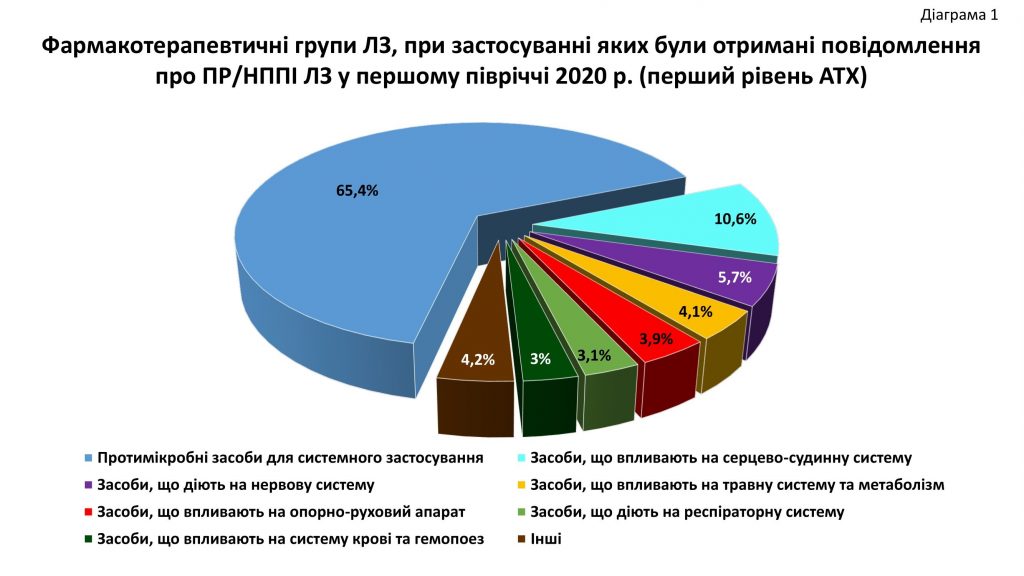
The predominance of reports of adverse reactions associated with the use of systemic antimicrobials remains unchanged (65,4%). The same figures were observed in 2019. In general, the distribution of pharmacotherapeutic groups of medicinal products has remained unchanged over all recent years. Compared with systemic antimicrobials, information on adverse reactions to all other groups by the first ATC level reaches the Center many times less often. Somewhat different is the share of reports associated with the use of agents affecting the cardiovascular system (10,6%), whereas reports of adverse reactions associated with the use of agents acting on the nervous system, the alimentary tract and metabolism, the musculoskeletal system, the respiratory system, and the blood and hematopoiesis account for, respectively: 5,7%, 4,1%, 3,9%, 3,1%, 3%. All other pharmacotherapeutic groups of medicinal products account for 4,2%.
Diagram 2, based on AISF data, presents 10 pharmacotherapeutic groups of medicinal products of the second level of the ATC classification out of 86, the use of which resulted in the largest number of reports of adverse reactions during the first half of 2020.
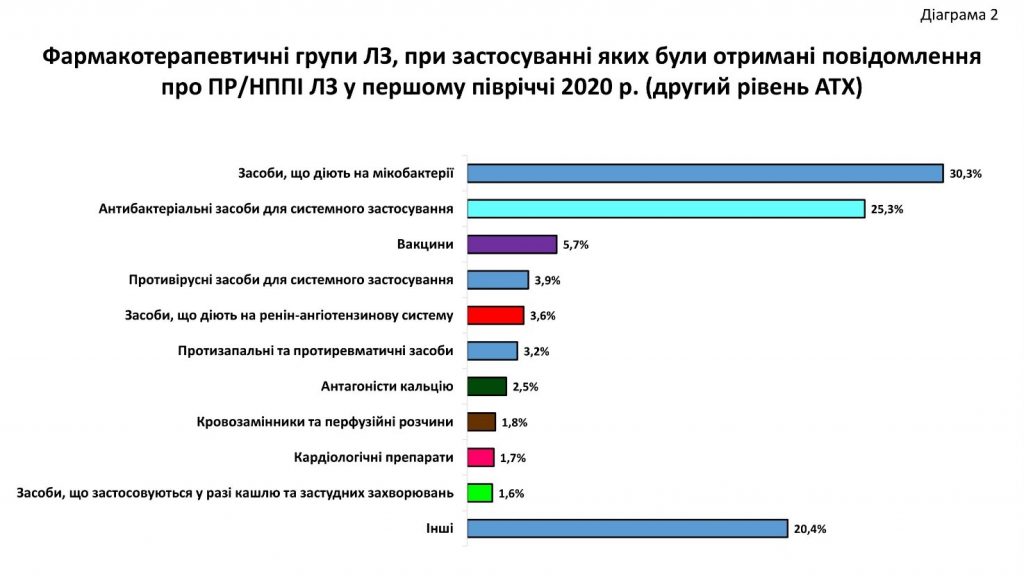
The largest share of reports on adverse reactions concerned the use of medicinal products acting on mycobacteria and antibacterial agents for systemic use. These two pharmacotherapeutic groups account for almost half of all reports received by the Center. Reports of adverse events following immunization with vaccines made up 5,7%. The share of reports for antiviral agents for systemic use, agents acting on the renin-angiotensin system, and anti-inflammatory and antirheumatic agents is, respectively: 3,9%, 3,6%, 3,2%. The share of reports of adverse reactions for other medicinal products was less than 3,2%. Among the total number of reports received on cases of adverse reactions in the first half of 2020, by degree of seriousness, non-serious adverse reactions made up 93,45% and serious ones 6,55%. The frequency of serious adverse reactions by reason of seriousness was: 0,84% – death, 20,97% – life-threatening, 19,13% – hospitalization of outpatients, 38,93% – prolongation of hospitalization, 1,68% – persistent disability, 0,50% – disability, and 17,95% other medically important health conditions.
During the reporting period, the Center received information about two deaths due to anaphylactic shock.
Anaphylactic shocks occurred after the use of one or a group of medicinal products administered simultaneously in healthcare facilities.
One of the cases occurred in a woman in an intensive care unit in the postpartum period when a blood substitute was used to replenish circulation. Manifestations of anaphylactic shock were observed immediately after the use of the suspected medicinal product. Despite the resuscitation measures taken, the patient died an hour after the administration of the blood substitute.
The second case occurred in a girl in an operating room during the administration of four medicinal products for general anesthesia during an operation to remove the appendix. 7 minutes after the administration of all the suspected medicinal products, signs of anaphylactic shock were recorded in the patient. Three hours after ineffective resuscitation measures, the biological death of the patient was declared.
It should be noted that year after year, the main and predominant cause of death of patients as a result of the use of medicinal products has been severe manifestations of anaphylactic shock that did not respond to drug correction.
In the first half of 2020, the share of expected adverse reaction reports received by the Center was 97,45% of the total number of reports. Unexpected reports accounted for only 0,01%. This refers to one case of an unexpected adverse reaction to the medicinal product Sodium chloride 0,9%. Clinical manifestations of the adverse reaction were chills, weakness, difficulty breathing, and a feeling of heaviness in the chest. The medicinal product was purchased by the patient independently at a pharmacy. The suspected medicinal product was not used in subsequent treatment.
By gender, the distribution of AR cases in the first half of 2020 is characterized by a slight predominance of cases in men (42,13%); women accounted for 38,92%. Information on ARs in girls and boys was received in equal numbers (7,22% and 7,48%). The most vulnerable group is patients aged 31-45 years. The fewest reports of ARs concerned patients older than 80 years. The lowest percentage of AR cases was noted in children from 0 to 27 days (0,09%) and in children aged 12-17 years (0,91%).
In connection with the COVID 19 coronavirus pandemic, reports of adverse reactions associated with the use of medicinal products used in the treatment of this disease were under special control. In Ukraine, MoH of Ukraine order of 02.04.2020 No. 762 (as amended by MoH of Ukraine order of 10.04.2020 No. 852) “On Approval of the Protocol ‘Provision of Medical Care for the Treatment of Coronavirus Disease (COVID-19)’” (hereinafter – the Protocol) was approved. Taking into account the medicinal products recommended in the Protocol that were prescribed for other indications or were not registered in Ukraine, the Center carried out careful monitoring of cases of adverse reactions to these medicinal products not only in Ukraine but also in Europe and the USA. The analysis of such cases was systematically published on the official website of the Center in the Pharmacovigilance section. 8 publications “Analysis of Spontaneous Reports of Cases of Adverse Reactions Associated with the Use of Medicinal Products in the Treatment of COVID-19 Received in VigiBase, Interim Results” were published for different observation periods, starting from April 2020. Reports with an analysis of applicants' reports of cases of adverse reactions associated with the use of medicinal products in the treatment of COVID19 that were received by the Center were published twice. A large summary review of safety data on medicinal products containing hydroxychloroquine and chloroquine during the treatment of COVID-19 by the U.S. Food and Drug Administration (FDA) was also published. This information is necessary for clarifying the safety and efficacy issues of medicinal products, assessing the benefit/risk balance and the advisability of their further use in patients with coronavirus infection.
Summarized quarterly information on cases of adverse reactions associated with the use of vaccines in Ukraine can be found on the official website of the Center at the linkhttps://dec.gov.ua/doctors/rezultati-diyalnosti-z-pitan-bezpeki-likarskih-zasobiv/?role=doctors.
