STRUCTURE OF THE PHARMACOVIGILANCE SYSTEM IN UKRAINE AND CONCEPTUAL REPRESENTATION OF THE PHARMACOVIGILANCE PROCESS
Pharmacovigilance is cyclical and continuous in nature. It all begins with the detection of a case of an adverse reaction to a medicinal product, which most often may occur in a healthcare facility (hereinafter – HCF), including a pharmacy, or at home, where the patient is being treated. After that, a healthcare professional with a medical or pharmaceutical education, the patient or the patient’s representative, or the applicant must report the case within the timeframes and in the format established by the legislation of the country. Information on cases of adverse reactions to medicinal products is sent in a single direction to the institution that coordinates pharmacovigilance in the country. It is there that such information is accumulated and analyzed, including risk identification and assessment of the risks and benefits of using the medicinal product. The results of the analysis form the basis for appropriate regulatory decisions, which must be made public and available both to the medical community and to the general public (Fig. 1).
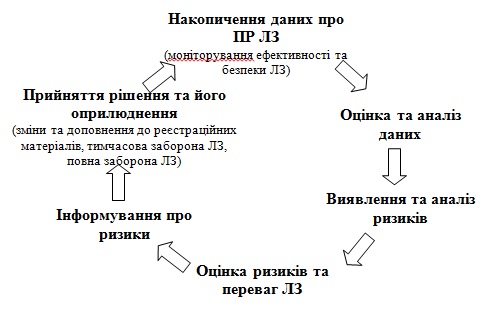
Fig. 1. Pharmacovigilance cycle
Pharmacovigilance is regulated by legislation, as is the entire process of medicinal product circulation.
In Ukraine, pharmacovigilance is regulated by the Law of Ukraine “On Medicinal Products” of 1996, as amended and supplemented in 1998, and by a number of orders of the Ministry of Health of Ukraine:
- Order of the Ministry of Health of Ukraine of 27.12.2006 No. 898 "On Approval of the Procedure for Pharmacovigilance of Adverse Reactions to Medicinal Products Authorized for Medical Use," as amended and supplemented by Order of the Ministry of Health of Ukraine of 29.12.2011 No. 1005 (hereinafter – Order No. 898);
- MoH order of 24.07.2009 No. 531 "On Approval of the Procedure for Monitoring the Safety and Efficacy of Medicinal Products in Inpatient Departments of Healthcare Facilities";
- MoH order of 01.09.2009 No. 654 "On approval of the Action Plan for improving post-registration surveillance of the safety and efficacy of medicinal products and monitoring of the safety and efficacy of medicinal products in inpatient healthcare facilities";
- MoH of Ukraine order of 31.08.2010 No. 736 "On Measures to Implement Monitoring of the Safety and Efficacy of Medicinal Products in Inpatient Departments of Healthcare Facilities".
The basic regulatory document governing the conduct of pharmacovigilance is order No. 898, which approved the “Procedure for Monitoring Adverse Reactions of Medicinal Products Authorized for Medical Use” (hereinafter – the Procedure).
The Procedure is harmonized with the provisions of the Directive of the European Parliament and of the Council of the EU of 06.11.2001 No. 2001/83 EC, as well as the Regulation of the Council of the EU of 22.07.1993 No. 2309/93 on the conduct of pharmacovigilance.
The Procedure defines the general principles of medicine safety surveillance and establishes the following sources of information on adverse reactions to medicinal products:
- employees with medical and/or pharmaceutical education (doctors, nurses, midwives, feldshers, pharmacists, pharmaceutical specialists) of all healthcare institutions regardless of form of ownership (form 137/0, appendix 1 to the Procedure);
- all health care facilities regardless of ownership type (form 69-zdorov, Annex 2 to the Procedure);
- State Service of Ukraine on Medicines (hereinafter – the State Medicines Service);
- manufacturers/applicants (or their representatives) (form for reporting an AR/lack of efficacy (LOE) of a medicinal product authorized for medical use, appendix 1 to the Procedure; regularly updated safety report on a medicinal product authorized for medical use, appendix 4 to the Procedure);
- patients and/or their representatives, organizations representing patients' interests (Annex 3 to the Procedure);
- regional pharmacovigilance departments of the Center;
- international organizations: United Nations International Children’s Fund (UnitedNationsInternationalChildren’sFund (UNICEF), World Health Organization (WHO), international agencies: European Agency for the Evaluation of Medicinal Products (The European Agency for Evaluation of Medicinal Products (EMA), U.S. Food and Drug Administration (Food and Drug Administration (FDA), Medicines and Healthcare Products Regulatory Agency of the United Kingdom (The Medicines and Healthcare Products Regulatory Agency (MHRA), Ministry of Health of Canada (Health Canada), Australian Therapeutic Goods Administration (TherapeuticGoodsAdministration (TGA), Swiss Agency for Therapeutic Products (SwissAgencyForTherapeuticProducts (Swissmedic), Japanese Pharmaceuticals and Medical Devices Agency (PharmaceuticalsMedicalDevicesAgency (PMDA) and others;
- medical information sources and scientific publications.
In accordance with the Regulation on the Ministry of Health of Ukraine (hereinafter – the Regulation), approved by Decree of the President of Ukraine of 13.04.2011 No. 467/2011, the MoH is the leading body in the system of central executive authorities in the formation and implementation of state policy in the field of health care, in particular in the field of quality control and sale of medicinal products, medical immunobiological preparations and medical devices, and combating HIV infection/AIDS and other socially dangerous diseases (paragraph 2 of clause 1 of the Regulation). Also, in accordance with the tasks assigned to it in the field of development, manufacture, quality control and sale of medicinal products, medical immunobiological preparations and medical devices, the MoH approves the procedures for surveillance of adverse reactions to medicinal products authorized for medical use (paragraph 11 of subclause 8.8 of the Regulation). The procedure for surveillance of adverse reactions to medicinal products authorized for medical use was approved by order No. 898, and the surveillance of adverse reactions to medicinal products authorized for medical use was entrusted by the MoH to the State Enterprise "State Expert Center of the Ministry of Health of Ukraine" (clause 1.3 of section 1 of the Procedure approved by order No. 898) (hereinafter – the Center).
The pharmacovigilance system in Ukraine has existed since 1996.
The state pharmacovigilance system is represented by a central link – the Department of Post-Registration Surveillance (hereinafter – the Department), which is a structural unit of the Center – and a regional network of regional branches (n=25) operating in all regions of Ukraine and the city of Kyiv. At the local level, the pharmacovigilance system is represented by persons responsible for carrying out pharmacovigilance in healthcare facilities, mostly deputy chief physicians or heads of departments. Ukrainian legislation provides for interaction between all structures involved in the circulation of medicinal products on matters of their safety. The functional and organizational model of the pharmacovigilance system of Ukraine is shown in Figure 2.
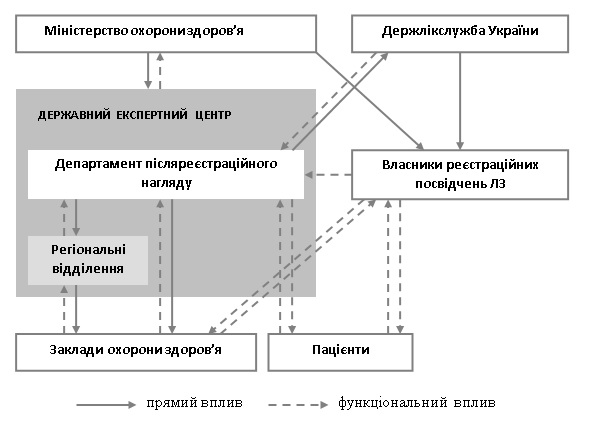
Fig. 2. Functional and organizational model of the pharmacovigilance system of Ukraine
The Procedure establishes the algorithm for physicians to submit notification cards on adverse reactions and/or lack of efficacy of medicinal products, shown in Figure 3.
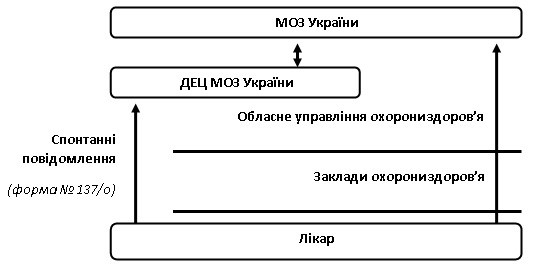
Fig. 3. Algorithm for receiving information on ADRs and/or LOE of medicinal products in Ukraine from physicians
In 2002, Ukraine became a full member of the WHO Programme for International Drug Monitoring and regularly submits information on cases of adverse drug reactions (ADRs) that have occurred during medical use in Ukraine. The information is based on spontaneous reports received from doctors. Data submitted in the appropriate format to the WHO Center (Uppsala, Sweden) are entered into the international database. This makes it possible to cooperate and, when necessary, exchange drug safety information with other countries participating in the WHO programme for monitoring ADRs of medicines via the VigiMed system. Reports of ADRs to midecamycin (2003) and vinpocetine (2010) received from Ukraine became the basis for the generation of a WHO signal* for these medicinal products.
As of 01.01.2013, Ukraine’s database of adverse reactions to medicinal products contains more than 52825 reports received from physicians (Fig. 4).
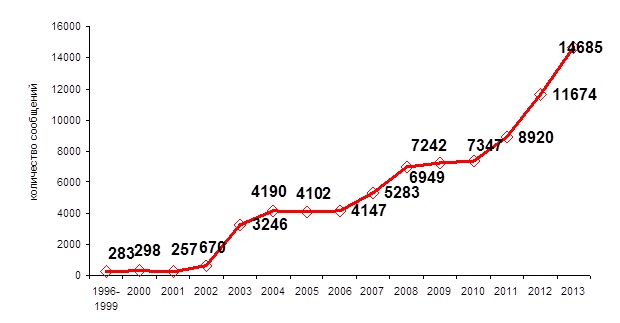
Fig. 4. Trends in the receipt of reports of adverse reactions to medicinal products from doctors in Ukraine
Every year the number of reports of adverse reactions to medicinal products grows due to the widening circle of those reporting such cases (Fig. 2). The latter is the result of the continuous work of the staff of the Post-Registration Surveillance Department (hereinafter – the Department) and its regional branches with the medical community. Owing to this, physicians' view of the problem of medicinal product safety is being shaped and they are being involved in pharmacovigilance.
According to WHO experts, a pharmacovigilance system is considered effective when at least 1 reports of adverse reactions to medicinal products are received per 100 million population per year. The optimal figure is 500 reports of adverse reactions to medicinal products per 1 million population. Switzerland is an example, where at least 500 reports of adverse reactions to medicinal products are received per year. In Ukraine in 2012, the rate of receipt of reports of adverse reactions to medicinal products reached 254 per 1 million population, which indicates a sufficient level of awareness, with potential for growth.
* A signal is information from one or more sources (including observations and experiments) that suggests a new causal relationship or a new aspect of a known relationship between an intervention and an event or a set of related events, whether adverse or beneficial, and that is sufficiently credible to justify verification actions.
(Report of CIOMS Working Group VIII of the Council for International Organizations of Medical Sciences “Practical Aspects of Signal Detection in Pharmacovigilance” (CIOMS, Geneva 2010))