Properties identical to the original medicinal product, extensive experience of use, and lower cost are the obvious advantages of generics. Every year they enter the global market, providing patients with better access to modern treatment. But despite their wide use in the world and in Ukraine, questions about what guarantees the declared properties of these medicines are not diminishing.
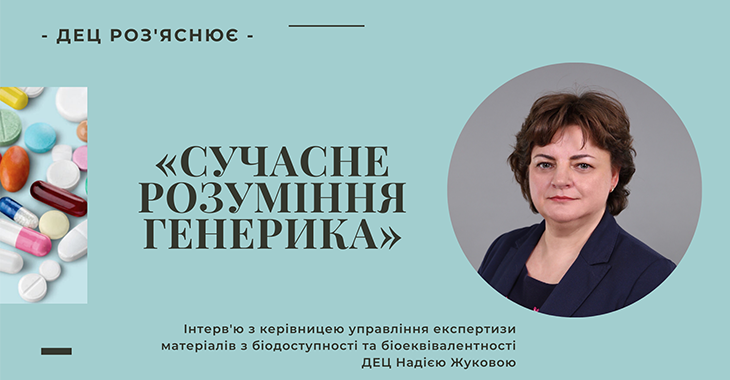
What a generic medicinal product is from the standpoint of legislation, how the generic nature of a medicinal product relative to the original is proven, which products are considered bioequivalent in the context of a generic, how regulatory approaches to proving generic nature and bioequivalence differ in various regions of the world – the head of the Department for Expert Evaluation of Bioavailability and Bioequivalence Materials of the Center Nadiia Zhukova answered these and other questions in an interview with Pharmanet.
Nadiia Oleksandrivna, what is a generic medicine from the standpoint of legislation?
From the standpoint of current Ukrainian legislation, a generic is a medicinal product that has the same qualitative and quantitative composition of active substances and the same dosage form as the reference product, and whose bioequivalence to the reference medicinal product has been demonstrated by appropriate bioavailability studies.
In the context of the definition of a generic under the requirements of Ukrainian legislation, it is important to consider that different salts, esters, ethers, isomers, mixtures of isomers, complexes or derivatives of an active substance are considered the same active substance, provided that they do not differ significantly in terms of safety and/or efficacy.
In addition, in the context of the definition of a generic, different oral immediate-release dosage forms are considered the same dosage form.
The applicant is not required to conduct a bioavailability study if they demonstrate that the generic medicinal product meets the established criteria defined in the relevant detailed guidelines.
What questions most often arise regarding generic medicinal products?
At first glance, when switching to cheaper and, accordingly, more affordable generic medicinal products, the health care system solves the problem of access to treatment for all segments of the population. But on the other hand, there must be solid evidence that generic medicinal products have the same safety, efficacy, and quality as the original products. After all, developers spent years of work and considerable funds to prove these properties and conducted all the necessary studies. By saving on studies, the developer of a generic medicinal product must prove that its product is not inferior to the original, that is, has similar properties. Therefore, the question of proving, at the current regulatory level, the genericity of a medicinal product relative to the original product always remains.
How is this proven?
Proof of similar properties is confirmed during the demonstration of generic status and, accordingly, bioequivalence to the original product. If all requirements for a generic under the current legislation of Ukraine and the regulatory agencies of countries with a strict regulatory system are met, a generic medicinal product can replace the original/reference product in clinical practice without any additional studies and adjustments.
Which regulatory documents of Ukraine set out the requirements for proof of genericity and bioequivalence?
Requirements for generic medicinal products and proof of their properties are set out in the Procedure for conducting expert evaluation of registration materials for medicinal products submitted for state registration (re-registration), as well as expert evaluation of materials on amendments to registration materials during the validity of the registration certificate, approved by MoH of Ukraine order No. 426 as amended by MoH order No. 460, in guideline ST-N MOZU 42-7.3:2020 “Medicinal products. Bioequivalence studies” of 6 November 2020, and in other documents.
Today, the approaches to demonstrating genericity and bioequivalence in our country fully comply with EU legislation. This is important because Ukraine has chosen the European path of development for itself, and so we are meeting the main condition for integration into the European community — harmonizing our regulatory framework and other documentation with the requirements of EU directives, regulations, and guidelines.
Under what conditions do applicants gain the possibility of registering generics?
It appears after the expiration of the exclusivity period and the patents for the original medicinal product. At this time, pharmaceutical manufacturers get the opportunity to produce and register generics, and the healthcare system — to replace (where appropriate) more expensive medicines with cheaper ones.
How should the concepts of “pharmaceutical equivalence” and “pharmaceutical alternatives” be understood in the context of a generic?
A medicinal product is pharmaceutically equivalent if it has the same quantitative and qualitative composition of the active substance, the same dosage form, and meets the requirements of the same or comparable standards. Usually, during the development of a generic product, it is planned to demonstrate pharmaceutical equivalence with the reference product, regardless of its dosage form.
As a rule, proof of pharmaceutical equivalence may be sufficient to demonstrate the generic status of a medicinal product for dosage forms in which the patient receives the active substance in a dissolved state. Depending on the dosage form, there are certain specifics in demonstrating pharmaceutical equivalence, taking into account the specific requirements for the particular dosage form.
For example, for oral solutions, bioequivalence studies must be conducted where the excipients in the generic medicinal product differ from the composition of the reference product and may affect passage through the gastrointestinal tract, absorption, transport proteins, in vivo solubility, or in vivo stability of the active substance, unless differences in the amounts of these excipients are adequately justified by reference to other data.
The requirements for the relevant dosage forms are set out in guideline ST-N MOZU 42-7.3:2020 “Medicinal products. Bioequivalence studies”.
In addition, pharmaceutically alternative medicinal products are those that contain the same active substance in the form of different salts, ethers, esters, isomers, mixtures of isomers, complexes or derivatives of the active substance, or that differ in dosage form or strength.
Which medicines are considered bioequivalent in the context of generics?
In the context of a generic product, two medicinal products containing the same active substance are bioequivalent if they are pharmaceutically equivalent or pharmaceutical alternatives, and their bioavailability (rate and extent of absorption) after administration of the same molar dose lies within predefined acceptability criteria.
It should be understood that pharmaceutical equivalence does not necessarily imply bioequivalence, since differences in excipients and/or in the manufacturing process may lead to faster or slower dissolution and/or absorption.
That is, proof of pharmaceutical equivalence and/or bioequivalence of the generic and reference medicinal products directly depends on the properties of the active substance and the dosage form.
How is bioequivalence confirmed in Ukraine? What has changed recently?
To prove the bioequivalence of generic and reference medicinal products, comparative pharmacokinetic studies or the biowaiver procedure based on the Biopharmaceutics Classification System (BCS) are used.
Currently in Ukraine, bioequivalence is demonstrated for almost half of generic medicinal products in accordance with the requirements of the current legislation. For the other generics recommended for registration, pharmaceutical equivalence is demonstrated. The share of generic medicinal products for which bioequivalence has been demonstrated through the biowaiver procedure based on the BCS is about 10-15%.
There is an opinion that a mandatory condition should be introduced for the registration of generics in Ukraine regarding conducting comparative clinical studies involving patients…
But such an opinion has nothing in common with regulatory approaches worldwide. Moreover, it calls into question the legitimacy and correctness of the registration of medicinal products. In addition, as already noted above, it is common practice worldwide to have regulatory requirements for generic products that provide for demonstrating their pharmaceutical equivalence and/or bioequivalence.
It should also be emphasized that, in accordance with the requirements of the current legislation in Ukraine, the approaches to conducting, standardizing, and evaluating bioequivalence studies are clearly regulated. This applies regardless of whether these are comparative pharmacokinetic studies or the biowaiver procedure based on the BCS. And all the norms contained in the guidelines approved by the MoH of Ukraine comply with the current guidelines of the European Medicines Agency EMA (European Medicine Agency).
How do regulatory approaches to demonstrating generic status and bioequivalence differ in different regions of the world?
The approach to proving genericity is the same in Ukraine and the European Union, the USA, Canada, the United Kingdom, and other countries with a strict regulatory system.
As for proof of bioequivalence, the requirements in Ukraine and the European Union are the same. However, it should be noted that the European Union's requirements for proof of bioequivalence differ from the corresponding requirements in the USA and Canada, the US requirements differ from the corresponding Canadian requirements, and the requirements of the European Union and the USA differ from the corresponding requirements of Japan, etc.
To date, such differences in requirements must be taken into account by all applicants planning registration in different regions of the world. And, in addition, it should be remembered that Ukraine's regulatory requirements for demonstrating bioequivalence correspond to those adopted in the European Union.
Are changes planned to the approaches to demonstrating bioequivalence?
The concept of bioequivalence remains unchanged. However, given that different regulatory requirements around the world make the development of generic medicinal products difficult, for the past five years there have been processes of harmonizing legislation on the demonstration of bioequivalence. The leading regulatory agencies of the world are trying to develop uniform approaches. The latest positive example of such harmonization of requirements is the introduction of uniform standards for the demonstration of bioequivalence under the biowaiver procedure based on the biopharmaceutics classification system. Ukraine’s regulatory requirements are being amended accordingly.
